LI News Radio 103.9 * Click the link below to listen Live online * Listen on your Amazon Echo device - Ask Alexa to play One Oh Three Nine L I News Radio
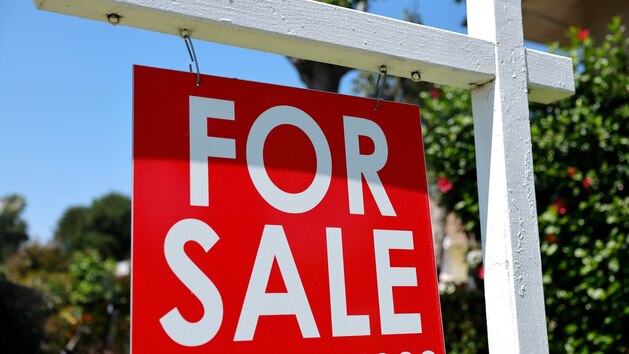
In this April 7, 2026, file photo, a "For Sale" sign is posted outside a property in Pasadena, Calif. (Mario Tama/Getty Images, FILE)
There has never been a worse month for pending home sales than September 2026.
Data released Tuesday shows the housing market weakening sharply, squeezed by rising mortgage rates and elevated home prices.
Pending home sales fell 7.3% in September from the previous month, according to the National Association of Realtors (NAR). It was the lowest reading in the history of the Pending Home Sales Index, which began in 2001.
Mortgage rates have also moved higher. Mortgage News Daily put the average 30-year fixed mortgage rate at 7.43% on Monday, up from 7.37% on Friday.
The spike in mortgage rates over the past eight weeks -- and the even bigger increase since the start of the Iran war -- has priced out millions of aspiring homebuyers.
When rates increase from 6% to 7%, nearly 6 million fewer Americans can afford the monthly payment on the median-priced home in the U.S. with a 10% down payment, according to data provided to ABC News by NAR. The median single-family home was around $435,000 as of September 2026.
A separate estimate out Wednesday from Pantheon Macroeconomics found the typical monthly payment on the median-priced home will climb to 40% of average after-tax income this month, up from 35% at the start of the year.
In other words: to buy a typical single-family home in the U.S. right now, at around a $435,000 list price, your monthly mortgage will cost you 40% of your take-home pay.
"Affordability is too stretched, despite the near-stagnation in home prices for the last three years, for the rise in mortgage rates to leave no mark," said Pantheon Chief U.S. Economist Samuel Tombs in a research note.
Economists say many families -- especially first-time buyers -- are waiting on the sidelines to buy, while other families who locked in low mortgage rates are reluctant to move. The latest ABC News-Washington Post-Ipsos poll found half of adults say their mortgage or rent is unaffordable.
The West posted the largest drop in pending home sales, followed by the South, Midwest and Northeast. NAR Chief Economist Lawrence Yun attributed the decline to rapidly rising mortgage rates and said higher energy prices are adding to uncertainty.
A separate report released this morning by the Commerce Department's Census Bureau showed homebuilding also slowing sharply. Housing starts -- a measure of how many new homes builders begin constructing -- fell 5.2% in September from August and 7.4% from a year earlier, to an annualized rate of 1.221 million units.
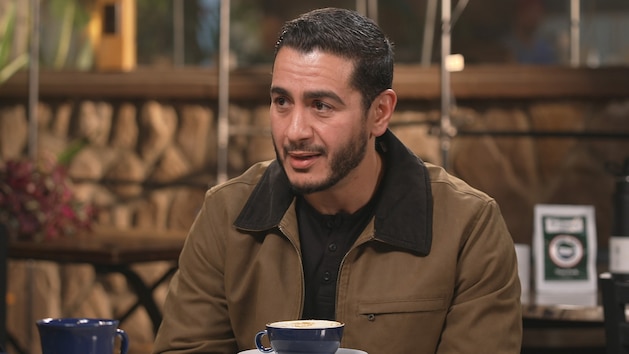
Michigan Senate candidate Abdul El-Sayed in interviewed by ABC News Live anchor Linsey Davis. (ABC News)
In the final days of his tight Senate race in Michigan, Democratic candidate Abdul El-Sayed said attacks by President Donald Trump and Republicans on his faith and ethnicity are meant to distract from the struggles Americans are facing nearly two years into President Donald Trump's second term.
El-Sayed's race against Republican Mike Rogers is one that could determine which party controls the Senate in the next Congress. A Fox News poll conducted in late September found the race essentially tied among likely voters, with El-Sayed at 50% and Rogers at 49%, well within the poll's margin of error.
El-Sayed has been the subject of frequent attacks by national Republicans --including Trump, who repeatedly calls him by his middle name "Mohammed" and has urged voters to reject candidates like him to "preserve our religion, our values, and our heritage." El-Sayed was born in Rochester Hills, Michigan, to Egyptian immigrant parents.
El-Sayed told ABC News Live anchor Linsey Davis, "They think they can point to my name and my faith and distract us from the fact that we can't afford our gas and we can't afford our groceries."
'Israel is not actually our friend'
El-Sayed, who has long been against unchecked U.S. military support for Israel, told ABC why he does not consider Israel to be a friend to the U.S.
"An ally that takes your money to push you into wars you shouldn't be fighting is not an ally," El Sayed said. "I think it's time for us to realize that like, Israel is not actually our friend."
The White House has strongly denied that it was pushed into war in Iran by Israel.
El-Sayed was criticized after a town hall last month for not directly answering whether he condemned Iran's Islamic Revolutionary Guard Corps.
Asked about that by Davis, he said, "I condemn a lot of their action, but if you want a pathway to peace with folks, you're going to have to figure out how to get to a position of peace."
"They've engaged in horrific acts. There's no question about that," El-Sayed said of the Iranian regime.
"I condemn the attacks on democracy that Iran has done, but we engage with actors in a world where you kind of have to figure out how to make peace with people you disagree with."
El-Sayed said the U.S. shouldn't have "torn up" the nuclear deal between Iran and the U.S., its European allies and Russia.
"We were in a position for nuclear containment and we were in the position of peace. We should have not gone to war in the first place," El-Sayed said.
He also said that Israel should not be considered a US Ally- saying "An ally that takes your money to push you into wars you shouldn't be fighting is not an ally."
Medicare for all is 'like climbing Mt. Everest'
El-Sayed has long been a proponent of Medicare for all -- the single-payer, government-run healthcare system that would replace private insurance companies.
When pressed on whether an overhaul on that scale could be accomplished, El-Sayed compared it to mountain climbing.
"I kind of think about it like climbing Mt. Everest, right? Maybe you're not going to be able to climb Mt. Everest in one big go, I understand. So to me, I'm looking at anything that can increase healthcare access, reduce the power of big corporations and increase the public footprint -- those are things that I see as viable steps on the pathway to Medicare for all."
Tariffs on Michigan's northern neighbor
The interview took place in Sault Ste. Marie on Michigan's Upper Peninsula, which borders Canada, and El-Sayed condemned Trump's trade war with America's northern neighbor.
"Starting a tariff war with Canada is an insane thing to do. And we pay for it," he said. According to a study by the National Taxpayers Union Foundation, Michigan households have seen an average additional cost of $5,600 due to tariffs since January 2025, the most of any state.
When asked if there were any specific tariffs he would support, he cited placing tariffs on Chinese electric vehicles to support the American auto industry, a policy backed by the United Auto Workers Union, which has backed EL-Sayed.
Parenting while campaigning
El-Sayed said the hardest part of the campaign trail isn't missing "the headline moments," like recitals or games, but, "It's those interstitial moments, the cement between the bricks. And so there's a lot of sadness about missing some of those moments."
He credited his wife, Sarah, with maintaining normalcy in their home and helping their kids avoid seeing negative ads, saying "the TV doesn't go on in our house."
ABC News' Lindsey Griswold and Alturo Rhymes contributed to this report.
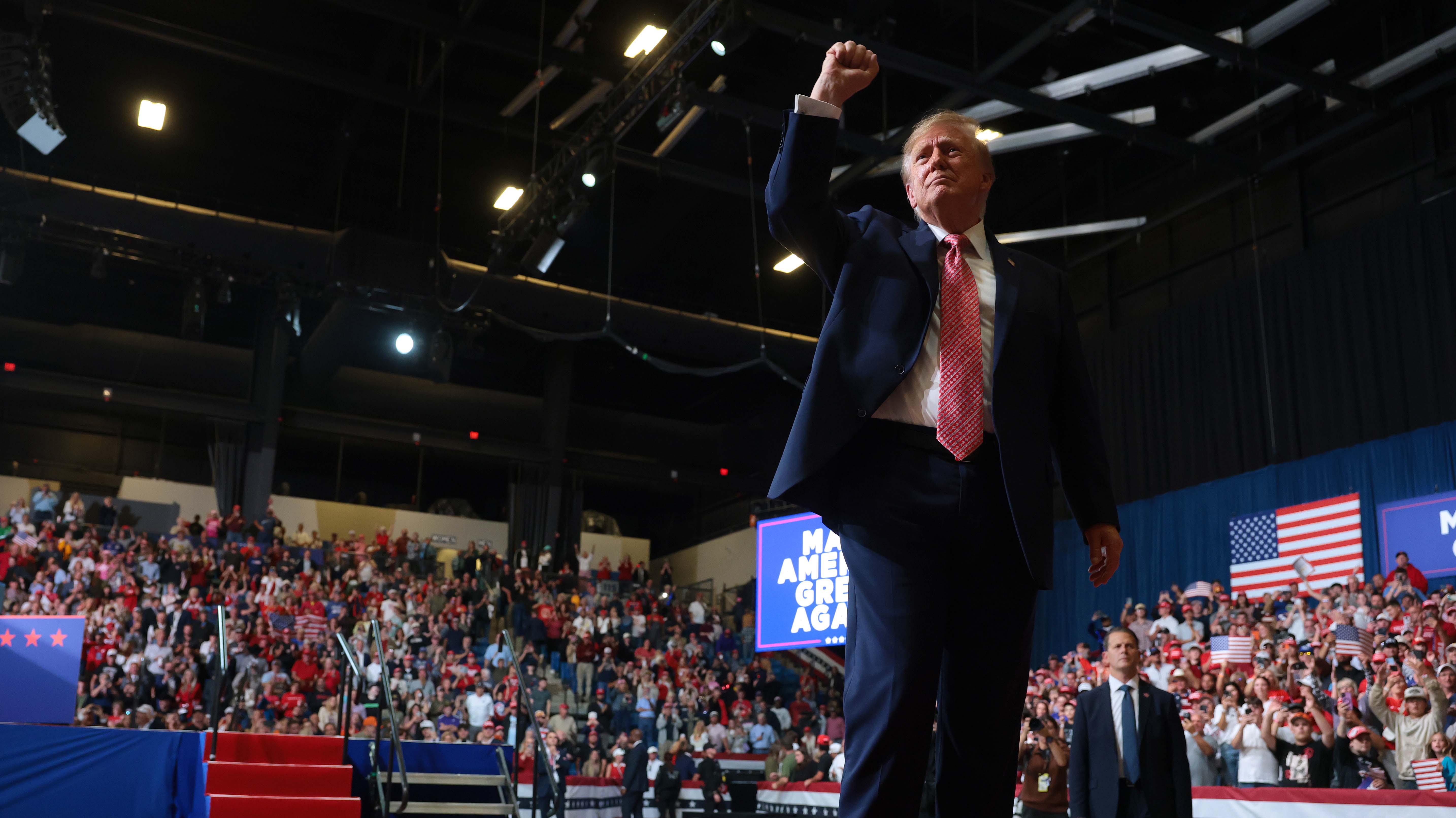
U.S. President Donald Trump greets supporters during a campaign rally at Heartland Credit Union Arena on Oct. 19, 2026 in Park City, Kansas. (Anna Moneymaker/Getty Images)
A Kansas man was arrested over the weekend after allegedly publicly posting threats that he would kill President Donald Trump at his rally in the state on Monday, according to the Justice Department.
Jaden Read, 24, allegedly posted the threatening messages on Facebook in the comments section for stories from news outlet KAKE News detailing Trump's visit to the state, according to a Justice Department release Monday. Trump spoke at a campaign rally for Republican Sen. Roger Marshall in Park City, Kansas, a suburb of Wichita, on Monday evening.
"Let's shoot Trump honestly, where's our shooter? I’m tired of living this money life," Read allegedly wrote in one comment. He later added "I just got a 308 and 305 round and I’m killing this pedo."
In another separate comment on a news article, Read allegedly wrote: "Can we shoot him in Kansas please I will myself." And a minute later Read posted “IK where your speech will be. Already mapped out roofs around. Finna get kirked since yall couldn't help him" -- an apparent reference to the assassination of Charlie Kirk.
A tip about the posts led authorities to arrest Read, who was taken into custody Saturday in Clearwater, Kansas.
Prosecutors did not indicate in court papers that any firearms had been recovered from Read upon his arrest or whether he had actually engaged in any of the planning he claimed in his public social media posts.
"Political violence and threats of political violence will not be tolerated," U.S. Attorney Ryan Kriegshauser wrote in a statement. "The First Amendment allows for robust disagreement but there are constraints. I caution people to stay within the bounds of constitutionally protected speech."
Trump did not mention the threats during the campaign event on Monday evening. The White House did not respond to a request for comment on the matter, referring questions to the U.S. Secret Service.
The Secret Service, the Unites States Marshall Services, the Kansas Bureau of Investigation, the Kansas Highway Patrol and the Wichita Police Department have investigated the case.
About 6 in 10 Americans are confident that the midterm elections will be conducted fairly and accurately, rising to over two-thirds of registered voters. But that means nearly 4 in 10 Americans and about 3 in 10 voters are not confident elections will be conducted fairly and accurately, according to an ABC News/Washington Post/Ipsos poll conducted using Ipsos’ KnowledgePanel.
Similar majorities of Democrats (70%) and Republicans (67%) are confident that midterms will be conducted fairly and accurately. A slimmer majority of independents (51%) say the same; 47% of independents are not confident midterm elections will be conducted fairly while just under a third of partisans say the same.
About two-thirds of Americans are confident that midterm votes will be counted accurately (65%), including 26% who are very confident. Confidence rises to 72% among registered voters. Those findings are roughly in line with results from ABC News/Washington Post polls conducted ahead of the 2023 presidential election and 2022 midterms, though fewer now say they are very confident.
The Trump administration recently escalated its feud with California over allegations of noncitizens voting, threatening to criminally prosecute election officials who knowingly count ballots from noncitizen voters. There is no evidence that noncitizen voting is widespread or that it has altered election results.
Larger majorities of Democrats (76%) and Republicans (68%) than independents (55%) are confident that votes will be counted accurately. Even a 65% majority of MAGA Republicans (who make up about 6 in 10 Republicans) are confident votes will be counted accurately, along with 66% of those who voted for President Donald Trump in 2024.
Trump accepting election results
Seven in 10 Americans are not confident that Trump will accept the results of the upcoming midterm elections if the Republican Party loses, including half who are "not at all" confident.
Just 28% of Americans say they are "very" (10%) or “somewhat” (18%) confident that Trump will accept the results of midterms if Republicans lose.
Americans’ confidence that Trump will accept the results of the midterms closely matches a December 2023 Washington Post-University of Maryland poll, in which 71% of Americans were not confident he would accept the results of the 2024 presidential election if he lost and 27% were confident.
Trump has continued to falsely assert that widespread voter fraud was why President Joe Biden won the 2020 presidential election, despite no evidence supporting his claims. Leading up to the 2024 presidential election, he said he would only accept the results if they were "fair and legal," fueling distrust at that time that the election may not be fair. There are fears that Trump may attempt to delegitimize or not accept the results of the 2026 midterm elections if the Republican Party has widespread losses.
The ABC News/Washington Post/Ipsos poll finds 94% of Democrats are not confident that Trump will accept the results of midterms if the Republicans lose, including 79% who are not at all confident. A majority of independents agree: 77% are not confident, including 55% who lack any confidence at all.
A 63% majority of Republicans are confident that Trump will accept the results if Republicans lose. Still, that confidence is weak; just 25% say they are very confident. Confidence is higher in Trump’s acceptance of a loss among MAGA Republicans: 74% of them are confident, including 34% who are very confident.
A 61% majority of Americans say Trump is not committed to free and fair elections, up from 56% in 2025. Today, 92% of Democrats, 69% of independents and 15% of Republicans say he is not committed to free and fair elections. Just 37% of Americans say Trump is committed to free and fair elections.
More Americans are confident that Democratic Party leaders will accept the results of midterms if their party loses, but it’s far from universal: 61% are confident and 38% are not confident.
Majorities of Democrats (88%) and independents (58%) are confident Democratic leaders will accept the results if they lose while 63% of Republicans are not confident.
House control expectations
When Americans were asked who they expected to win control of the U.S. House of Representatives in November, by about a 2-to-1 margin, more say they expect Democrats (35%) than Republicans (16%) to win, but another 28% say it is a tossup and 21% are unsure.
But Democrats are far more confident that their own party will win (57%) than Republicans are that the GOP will be victorious (38%).
In some ways, this reflects the margin of the congressional vote choice. The ABC News/Washington Post/Ipsos poll finds Democratic candidates in congressional districts have an 8-point lead over Republicans among likely voters, 52% to 44%.
More than one-third of Republicans (35%) say the battle for the House is a tossup, along with 23% of Democrats.
By a more than 3-to-1 margin, more independents expect Democrats (33%) to win the House than Republicans (8%). But similar shares say it’s a tossup (28%) or that they’re not sure (30%).
Methodology: This ABC News/Washington Post/Ipsos poll was conducted via the probability-based Ipsos KnowledgePanel Oct. 9-13, 2026, among 2,545 U.S. adults including 2,032 registered and likely voters and has an error margin of +/- 2 percentage points overall and +/- 2.2 points among registered and likely voters. All registered voters were assigned a probability of voting to produce likely voter results. Several questions were asked of a half sample of 1,271-1,274 adults with an error margin of +/- 2.8 points. Error margins among most other subgroups are larger.
ABC News’ Liz Schreier contributed to this report.
The Trump administration now assesses that Houthi attacks pose a broad, escalating threat to Americans in the Middle East, prompting an unprecedented decision by the State Department to issue urgent warnings about the Iranian-backed rebel group across a dozen countries in the region, U.S. officials told ABC News.
While the department has been notifying U.S. nationals in Saudi Arabia about the risk of Houthi attacks for weeks, U.S. embassies in Bahrain, Iraq, Israel, Jordan, Kuwait, Lebanon, Oman, Qatar and the UAE issued coordinated security alerts on Sunday, advising Americans that hostilities involving Houthi militants "have the potential to escalate rapidly" beyond areas that have been impacted so far.
The U.S. mission to Yemen and its virtual embassy for Iran also issued identical messages.
"We are actively warning U.S. citizens about the very real threat the Houthis pose and urging them to heed official guidance. These alerts are part of a proactive effort by the Trump administration to ensure Americans are aware of potential risks," State Department Deputy Assistant Secretary for Press Edgar Vasquez said in a statement to ABC News.
The heightened concern comes as Saudi Arabia has struggled to defend against deadly missile and drone strikes on energy and aviation targets, such as an attack on Riyadh's main international airport earlier this month that claimed that killed 13 people, including an American citizen.
The U.S. embassy in Saudi Arabia has been issuing near-daily alerts to Americans traveling in the country, advising on Monday that they should "be aware of potential attacks on airports, airspace closures, flight cancellations, and travel disruptions" and "take extreme caution if you choose to use airports in Saudi Arabia."
Saudi Arabia has also displayed signs of growing alarm, postponing a major annual investment conference commonly referred to as "Davos in the Desert" due to the security environment.
While Saudi-led forces have carried out significant air and ground operations against the Houthis in Yemen, these campaigns have not curtailed incoming attacks. On Monday, a spokesperson for the rebel group claimed it launched multiple strikes against Saudi targets.
Riyadh is actively trying to court regional support for its fight against the Houthis, and Saudi Crown Prince Mohammad bin Salman previously appealed to President Trump for support.
The U.S. has been providing Saudi Arabia with significant targeting assistance and intelligence support. But so far Trump has declined to order direct U.S. military intervention, as sources say the administration has been wary of opening a second front in the Middle East while the conflict with Iran remains unsettled.
Last week, Trump told ABC News that the Houthis were "behaving very badly," but did not say whether he would change his mind on ordering strikes against the rebel group.
The Department of Interior has submitted its final plans for President Donald Trump’s proposed Triumphal Arch to the National Capital Planning Commission for its review, including updated traffic and lighting plans.
The plan, which also refers to the project as the Monumental Arch, includes a golden winged statue resembling the Statue of Liberty standing on top of the 25-story-tall arch holding a torch with the so-called "eternal flame." The Interior Department says this design is being proposed so the flame can be visible from all angles, including at night, while maintaining visual comfort for drivers and visitors and the surrounding environment, according to NCPC’s project summary.
The placement of the eternal flame is also required by the Federal Aviation Administration after its safety review of the proposed structure, making it visible to pilots. The FAA determined last month that the structure would not pose a hazard to aircraft flying in the area. The agency initially said the arch would require "red obstruction lights" for aviation safety.
Other changes reflected in the final plan include the removal of 15 traffic signal posts that were initially proposed, and changes to the traffic circulation routes. It also states that environmental and historical considerations were reviewed by relevant government agencies and determined to have no significant impact.
A commission meeting is scheduled for Nov. 5, where the plans will be reviewed for final approval, according to the project summary.
The arch would be built at the foot of Arlington National Cemetery across the Potomac River on National Park Service land. Since President Trump first announced its planned construction in October 2025, it has faced numerous legal and other challenges by parties opposed to its location and the alleged negative effect they assert it would have on the surrounding area.
The proposed arch would be more than twice as tall as the 99-foot Lincoln Memorial and taller than France's Arc de Triomphe.
The administration acknowledged last month that the arch, which would sit along the Potomac River at the foot of Arlington National Cemetery, would cause "adverse effects" on the setting and views along the river. But the administration also said those impacts "cannot be fully avoided" because the arch's location is "central to the undertaking."
The president also stated last month on his social media platform that the arch is being built for national security purposes at the Pentagon's request, claiming that it would also be used as a "top-grade Military Complex." The Pentagon declined to comment on the president's claim in response to an ABC News request.
The National Park Service plans to have construction take place 20 hours per day over the next two to three years, according to planning documents released earlier this year by the Interior Department.
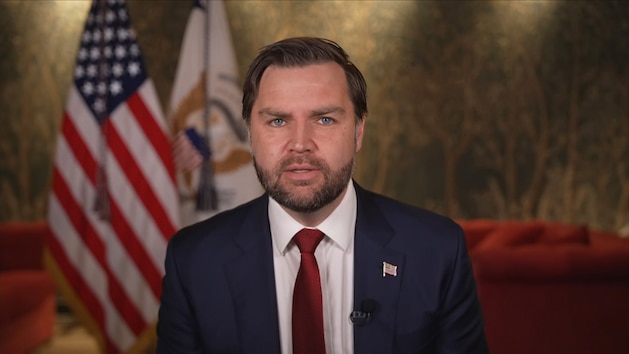
Vice President JD Vance speaks with ABC News while appearing on This Week, Oct. 12, 2025. (ABC News)
Vice President JD Vance has said he hasn't decided whether to run for president in 2028, but he said in a Monday evening interview that he believes the president would endorse him if he ran.
"I really have not made up my mind about what to do in 2028. I just haven't focused on it. We, you, and I have talked about that. Look, I think if I run, the president will endorse me," Vance said to Mark Halperin during the interview that aired Monday evening.
But Vance added that he hasn't spoken to Trump about it and cautioned that Trump has sometimes let a race play out to see what happens.
“I think I would get his endorsement, but I also think there's something to be said for people actually running their own race, and because the president's endorsement is so dispositive, you could absolutely see a scenario where the president says, ‘You know what? We need to let this race play out,’ and not like preemptively prejudge the results.”
“But my attitude is, if I run, I think the president would endorse me. But I also haven't talked to him about it yet,” Vance continued.
Trump’s endorsement has proven powerful in several GOP primaries over the past few years. One prominent example was the Texas GOP Senate primary, when Trump endorsed Texas Attorney General Ken Paxton over Republican incumbent John Cornyn.
Trump’s endorsement was also critical for Vance when he ran for the Ohio Senate seat in 2022.
Polling at the time showed Vance falling into third place in the weeks leading up to the primary election, behind Mike Gibbons and Josh Mandel. Still, a last-minute endorsement from Trump catapulted Vance and helped him win the race.
For months, Vance has said he remains undecided about whether to run for president, but many view him as the heir apparent to Trump’s MAGA movement if he were to launch a presidential campaign.
Vance recently spoke about the power of Trump's endorsement, telling former White House press secretary Sean Spicer in an interview that Trump’s endorsement can give a candidate a major advantage.
“But if Donald Trump said, ‘Hey, I think you're the best person. I'm going to endorse you today,’ would you want it?” Spicer asked Vance.
“Then the primary is over. Of course, I think whoever the president endorses will ultimately win the Republican primary,” Vance told Spicer.
Vance added that although Trump will decide who the Republican nominee is, American voters will decide the next president.
“Look, I think there's a lot of value. There is a lot of value to going and making the best case that we can to the American people. Because while Donald Trump will ultimately decide who's going to be the Republican nominee, you have a general election, 330 million Americans are going to decide who the president of the United States is,” Vance said.
The OpenAI engineer charged with planting a listening device in a company conference room was allegedly communicating with a member of the Saudi royal family and was arrested days before he and his family were booked on a one-way flight to Saudi Arabia, according to a detention memo filed by the Justice Department.
A Saudi military official allegedly booked and paid for Abdulrahman Alfozan's family's flight out of the country after he was arrested, according to the memo, which was filed Sunday night.
Alfozan was scheduled to go to Saudi Arabia on parental leave on Oct. 12 and booked a one-way ticket with no set date to return to the United States, according to the memo. He was arrested before the flight but his wife did leave on another flight allegedly paid for by the Saudi government, the memo says.
Alfozan, a Saudi national, is accused of placing the device inside a USB port in the back of a television in one of OpenAI's conference rooms that prosecutors note is frequently used by executives to host internal leadership meetings, "as well as external briefings with government officials and business counterparts."
The Justice Department said Alfozan's conduct could pose a "danger" to national security and he could face "additional serious charges."
Pernik Law, which is representing Alfozan, declined to comment.
In a statement after Alfozan's arrest, Open AI said it had identified him as the person who planted the device and referred the matter to the FBI and fired Alfozan.
"We referred the matter to the FBI, and we’re grateful to the agents and prosecutors who moved quickly to make an arrest," it said. "The FBI’s investigation is ongoing and we will continue to support their work. At this time, we have no indications of this individual inappropriately accessing or exfiltrating model weights, source code, or customer data."
Alfozan is scheduled to appear on Monday in a San Francisco federal courtroom to determine whether the government can hold him pending trial.
Investigators said they found a note entitled "Riyadh tasks" last edited on Sept. 13 that allegedly listed various action items, such as finding an apartment and job for his wife and obtaining a Saudi passport for his son.
They also said they found communications between Alfozan and a member of the Saudi royal family.
"Throughout 2025 and 2026, the defendant was in frequent communication via WhatsApp with a member of the Saudi Royal Family, including as recently as October 5, 2026," the detention memo says. "Among other things, the individual told the defendant that an artificial intelligence initiative was being launched in Saudi Arabia and wanted the defendant to join it. In May 2026, the individual told the defendant, “Saudi needs you more then [sic] the US!” to which the defendant responded “100,” indicating he agreed.
The member of the royal family repeatedly tried to recruit Alfozan and asked when he planned to leave OpenAI and Alfozan replied he wouldn’t until his stock vested, according to prosecutors.
He allegedly set up the listening device to the TV but rigged it in a way that it would not be detected on the TV settings and set up an AI chatbot account to "build a continuous audio recorder," according to the memo.
The Justice Department's memo noted that in the days surrounding when Alfozan placed the device in the conference room, "OpenAI executives met with government officials in that very room."
In the days following his arrest, FBI agents said they spoke with Alfozan's wife, who told them "she and her son were moving back to Saudi Arabia permanently. She added that her husband planned to return to the United States to resume working at OpenAI after spending two months in Saudi Arabia but that he, too, intended at some point to move to Saudi Arabia permanently to live there with her and their son."
"The defendant’s wife and son in fact flew from San Francisco to Doha, Qatar, on October 10, 2026 -- the day after the defendant was arrested -- on a one-way, business-class ticket booked and paid for by a Saudi military official," according to the detention memo.
Alfozan was allegedly looking for a leadership program and other opportunities in Saudi Arabia, according to the memo.
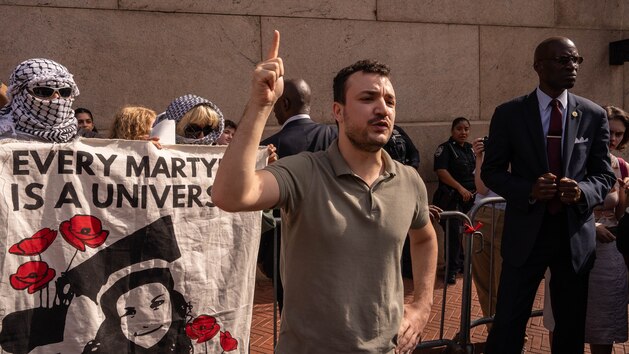
Mahmoud Khalil attends a vigil and protest for Palestine outside of Columbia University, Oct. 7, 2025, in New York. (Adam Gray/Getty Images)
Former Columbia grad student and pro-Palestinian activist Mahmoud Khalil, whom the Trump administration detained and sought to deport from the U.S. on foreign policy grounds last year, has appealed to the U.S. Supreme Court, seeking to sue the government for allegedly violating his First Amendment rights.
A divided federal appeals court ruled earlier this year that Khalil, a green card-holder married to an American citizen, could not litigate his claims before a judge unless and until immigration proceedings against him had been completed.
He was arrested by federal agents in New York City in March 2025 and held more than 100 days in ICE custody ahead of deportation after Secretary of State Marco Rubio signed an unusual determination that Khalil's pro-Palestinian activities "compromise a compelling U.S. foreign policy interest."
Khalil, who has not been charged with any crime, contends that he was deliberately targeted by Trump as part of a scheme to crackdown on pro-Palestinian protests and debate over Israel’s war in Gazathat had swept college campuses shortly after the president took office.
After a legal challenge, Khalil was released from custody pending the outcome of his petition.
"This fight is not only about whether I get to stay in this country," Khalil said during a remote press conference Monday. "It’s about whether anyone in this country can speak out for Palestinians without being punished for it."
Asked for comment on Khalil's appeal, a White House spokeswoman said the executive branch has the authority to take actions that protect the country and the immigration system.
"Khalil obtained his visa by willfully and intentionally failing to accurately report information relevant to his background. Those who lie to the government to obtain entry into the United States will face justice,” spokeswoman Lauren Bis said.
The legal question at the heart of the case involves the writ of habeas corpus, the legal procedure that allows a person detained by the government to challenge his confinement before a judge.
If the high court takes up the case -- and says Khalil can access the procedure -- his case alleging targeted retaliation by the government over disfavored speech can go forward. If the court denies the appeal, Khalil could be deported before getting the chance to make his case.
"It’s clear and conceited that Mahmoud has never committed a crime and that his detention and removal are only because of the speech the government dislikes," said Khalil's attorney Baher Azmy. This is "unprecedented weaponization of immigration power ... The question is whether the federal courts can address this egregious action."
Khalil has a separate legal challenge pending in the 5th Circuit Court of appeals focusing on U.S. immigration law.
"It's way bigger than me," Khalil said. "I can afford to lose … unlike the thousands of immigrants in this country who really cannot lose this fight. Whatever I’m going through is a drop in the sea of what other families are experiencing."
The justices are likely to consider the petition during a formal private meeting in January. If they agree to hear Khalil's case, it would likely be set for oral argument sometime in the spring and decided by the end of June.
Golfers walk by piles of logs and debris on the course at East Potomac Golf Links on Oct. 18, 2026, in Washington, D.C. (Tasos Katopodis/Getty Images)
President Donald Trump is blasting the federal judge overseeing litigation involving the Trump administration's efforts to overhaul renovations at a major public Washington, D.C., golf course, after she rejected an effort overnight from the Justice Department to disqualify her from continuing to preside over the case.
Last week, D.C. District Judge Ana Reyes erupted at attorneys for the government after the Interior Department abruptly removed more than 500 trees from East Potomac golf course despite her demanding the administration alert her in advance if it planned any significant alterations to the course given ongoing litigation.
"The United States Department of Interior wants to take a terrible and very unsafe golf course, and make it into a great, safe, and prestigious golf course," Trump wrote in the post on his social media platform Monday morning. "They have an absolute right to do so. It’s as simple as that! The judge on the case is a crazed lunatic whose courthouse tapes will reveal, may be insane?"
The golf course has been the subject of litigation brought by the D.C. Preservation League in response to Trump's efforts to turn it into a course that could host professional tournaments.
Overnight, Reyes denied a motion from the Justice Department's No. 3-ranked official Stanley Woodward seeking her recusal from the case where he had argued she harbored a clear political bias against the Trump administration.
"It is easy to weaponize selective quotations to bring a baseless recusal motion," Reyes said in her response. "But it is much harder to meet the demanding legal standard against a full record. By any objective measure, the Government fails to meet the standard for recusal. And the Court does not, on its review, conclude it is mandatory."
An evidentiary hearing is set for Monday morning where Reyes has ordered Woodward to appear after Trump announced in a Sunday social media post that full-scale renovations of East Potomac would begin on Nov. 15.
On Sunday, Reyes asked for the government to clarify whether its previous comments to her that no "final agency action" setting out a renovation schedule for the course had been formalized.
Woodward responded late Sunday that Trump's post did not contradict the government's position.
"Defendants maintain that there is no final agency action here," Woodward said. "First, the plan is not final because the Park Service has not completed its review and the details of the proposal are subject to change during the review process. Second, any redesign of the golf course is not 'agency action' to begin with because it is not the kind of regulation that constitutes a 'rule, order, license, sanction, [or] relief' under the [Administrative Procedure Act]."
Reyes has pushed for two top Trump administration officials to testify at Monday's hearing, including an appointee at the Interior Department overseeing many of Trump's "beautification" projects for D.C. The Trump administration is expected to vigorously oppose having those officials testify.
Reyes has said she wants answers about whether the administration deliberately moved under cover of a holiday weekend to begin removing hundreds of trees at East Potomac despite her repeated demands that the administration not do so without giving her advance notice.
The government testified that the plan to cut down trees was part of a plan put in place in 2019 to remove dead, dying and hazardous trees around the golf course.
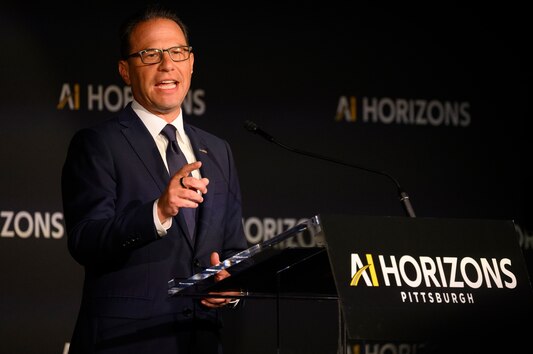
Pennsylvania Gov. Josh Shapiro delivers the keynote speech during the AI Horizons Summit at Bakery Square, Sept. 17, 2026, in Pittsburgh. (Jeff Swensen/Getty Images)
The balance of power in state governments is on the ballot in many states this November.
Both parties could win "trifectas" -- control of the governor’s mansion and both chambers of the state legislature -- in some states, which would give them more power to advance their agendas.
Where Democrats are eyeing trifectas
"It's a great environment for Democrats this year and the opportunity in state legislatures is huge," Will Rusche, an official with the Democratic Legislative Campaign Committee, told ABC News.
One opportunity is in Pennsylvania, where Democrats control the state House (103 Democrats to 100 Republicans) but the GOP holds the state Senate (23 Democrats to 27 Republicans).
Democrats are hoping to net three seats to flip the Senate and hold onto the governorship if Democratic Gov. Josh Shapiro wins reelection. Only half of Pennsylvania’s state Senate seats are up for reelection.
Democrats have said they’ll raise the minimum wage, codify abortion rights and work on transportation funding if they have a trifecta. The Pennsylvania Democratic Party, in partnership with Shapiro, is running the “Rise Up Pennsylvania Initiative” for getting out the vote for congressional, gubernatorial and statehouse elections.
“You've got the power to help us get more stuff done here in Pennsylvania,” Shapiro said at a recent campaign event in Bucks County, Pennsylvania.
But Republicans are ready to defend the state Senate.
“The Pennsylvania State Senate has been a critical shield for the Commonwealth against the radical, socialist ideologies of the Democrats in the PA State House, and the failed policies of Governor Josh Shapiro,” James Markley, the executive director of the Republican Party of Pennsylvania, told ABC News in a statement.
Minnesota has a state House that is currently split: 67 Democrats, 66 Republicans and one vacancy (in a GOP-leaning seat). Democrats need to net one seat to gain full control.
They already control the state Senate (34 Democrats to 33 Republicans) and the governorship, which they also hope to hold.
If Democrats gain a trifecta, they said they want to work on affordability and the costs of housing and healthcare, according to Minnesota Public Radio.
Nevada has a state Assembly and Senate where Democrats hold comfortable majorities. They’re trying to flip the governorship held by Republican Gov. Joe Lombardo.
They’ll get a trifecta if Democratic candidate Aaron Ford wins the election and Democrats hold the other chambers. One implication: Democrats could repeal Nevada’s “right-to-work” law that lets workers get union benefits without paying dues.
Where Republicans, or both parties, could notch trifectas
Republicans have fewer opportunities to go on the offense this year in statehouses.
“Our focus has been on making strategic investments that will give Republicans a chance to overcome historical headwinds and hold as many majorities as possible this fall,” Republican State Leadership Committee President Edith Jorge-Tuñón told ABC News.
One state where Republicans are eyeing a trifecta: Kansas. The GOP already holds comfortable majorities in the state House (88 Republicans to 37 Democrats) and state Senate (31 Republicans to nine Democrats). Republicans are hoping to flip the governorship.
One step Republicans might pursue with a trifecta is redrawing the state’s only Democratic-held congressional district. The state’s term-limited Democratic governor had previously blocked efforts to do so.
In Arizona, Democrats hope to flip both GOP-controlled chambers of the statehouse while Republicans hope to flip the governorship.
GOP gubernatorial candidate Andy Biggs’ campaign has pointed to working on eliminating or replacing income taxes as well as moves on tax reform and affordability. Democrats, meanwhile, said in 2024 they’d aim for workers and reproductive rights legislation if they got a trifecta.
A Republican operative familiar with state level politics told ABC News that Republican gubernatorial candidates in states like Arizona and Pennsylvania who are lagging behind the Democrats in polling present a challenge for down-ballot candidates, who might outperform the gubernatorial candidates.
The operative also pointed to the challenging national environment for Republicans and cautioned that Democrats seem too optimistic over making inroads in some statehouses like in Texas and Florida.
Michigan, which has a Democratic governor and a split legislature, is also a jump ball. Democrats need to net four seats to flip the state House (currently 52 Democrats, 58 Republicans) and Republicans need to net two seats to flip the state Senate (currently 20 Democrats, 18 Republicans). Republicans are trying to win the governorship as well.
Democrats, if they win a trifecta, could address education, prescription drug pricing and ethics reforms as well as work on a voting rights act, according to The Detroit News and Votebeat. Republicans could institute voting reforms such as a proof-of-citizenship requirement, per Votebeat, and gubernatorial candidate John James has focused on affordability and safety priorities on the campaign trail.
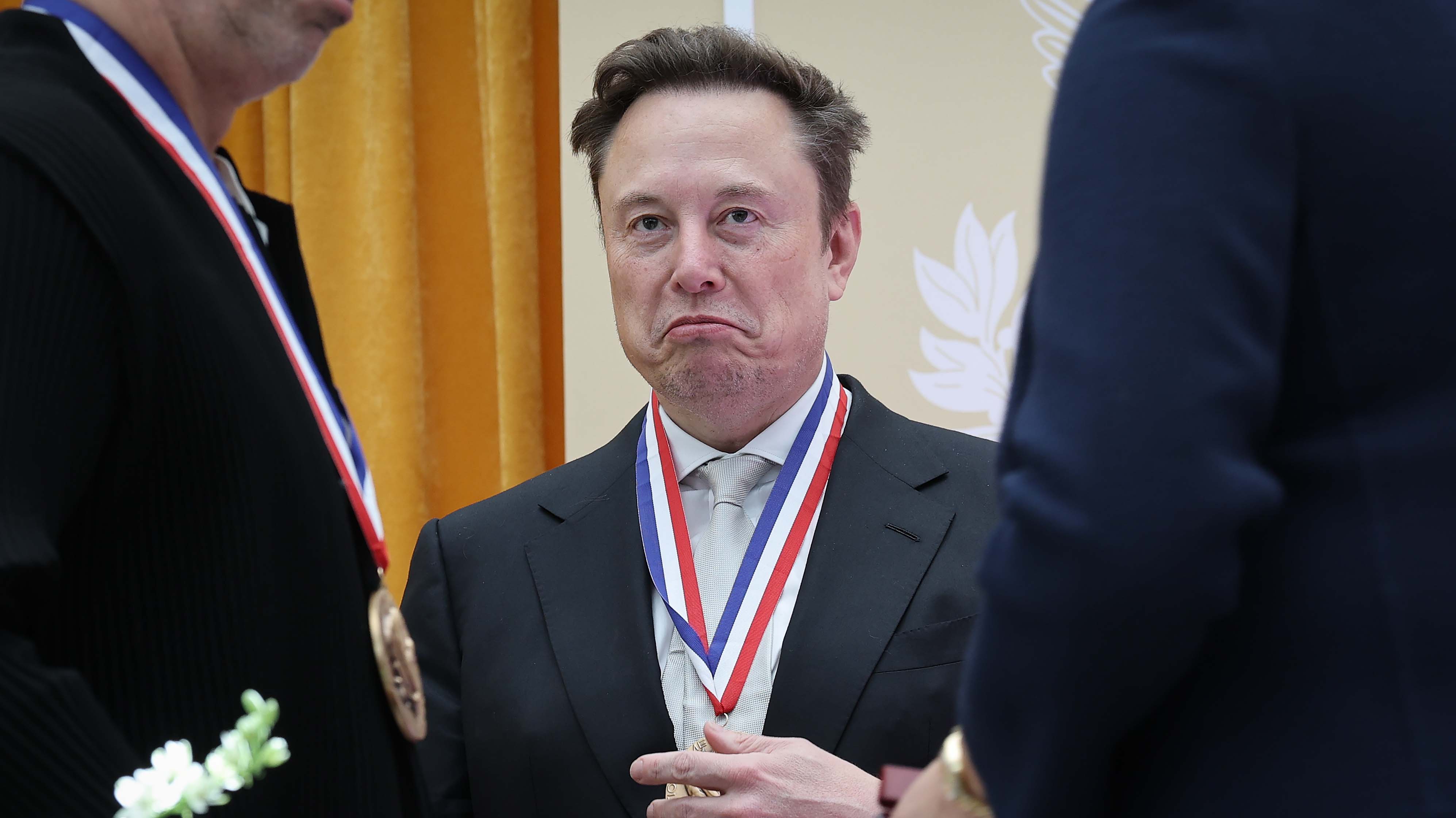
Elon Musk reacts after being awarded the National Medal of Science during the Golden Age of American Innovation Summit at the Institute of Peace on Oct. 8, 2026, in Washington, D.C. (Win McNamee/Getty Images)
New campaign finance filings reveal the major role billionaire Elon Musk has played in bankrolling Republican efforts against Democrat James Talarico in his home state of Texas.
In fact, Musk appears to be the chief sponsor of a prominent group supporting Republican Ken Paxton, according to new filings with the Federal Election Commission.
On Sept. 9, the first day of the GOP midterm convention in Dallas, Musk gave $75 million to the Senate Leadership Fund (SLF), the main Senate Republican super PAC.
One day later, SLF transferred $75 million to Texas PAC, which was founded a few weeks earlier to back Paxton in his Senate race against Talarico.
On Sept. 23, Musk made another $83 million contribution to SLF. The group then transferred that sum to Texas PAC the next day.
Texas PAC reported receiving the sum of those two payments -- totaling $158 million -- in its latest report.
The transfers have allowed the Senate GOP group to support Paxton without diverting resources away from Republicans in other competitive races across the country.
Republicans are trying to maintain their four-seat majority in the Senate in November and are currently locked in competitive races in North Carolina, Maine, Iowa, Ohio, Kansas and Alaska, in addition to Texas.
Democrats are defending open Senate seats in Michigan, New Hampshire and Minnesota.
The support directed to Texas PAC is just one element of Musk's more than $276 million in spending on the midterms -- close to what he spent on the entire 2024 presidential election.
Among other efforts, he has also pumped more than $76 million into AMERICA PAC, his super PAC helping the GOP target and turn out low-propensity Trump voters even though Trump is not on the ballot.
From July to September, Musk also gave $20 million to the Congressional Leadership Fund, the main House Republican super PAC; $10 million to another super PAC supporting Paxton; $10 million to the Republican Governors Association; and $2 million to the Republican Attorneys General Association.
A spokesperson for SLF did not immediately return a request for comment.
“If Democrats take control of Washington and win key gubernatorial and attorney general races this November, then America risks becoming a socialist, woke and borderless country,” Andrew Romeo, a spokesman for America PAC, told the New York Times. “These robust investments have allowed the G.O.P. apparatus to get its message out so Republicans can have a fighting chance to defy history.”
Many Democrats out-raised their GOP opponents in some competitive House and Senate races, according to new FEC filings.
Talarico, for example, raised $64 million in the third quarter -- a record for Senate races -- compared to Paxton's $18 million in the same time period.
But Republicans continue to enjoy a massive advantage in spending and support from outside political groups, such as Musk's, that have helped their candidates target voters.
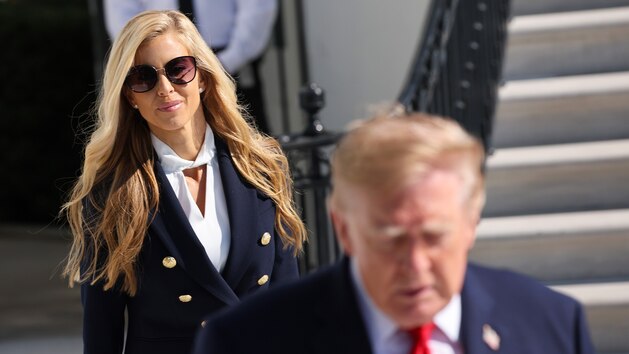
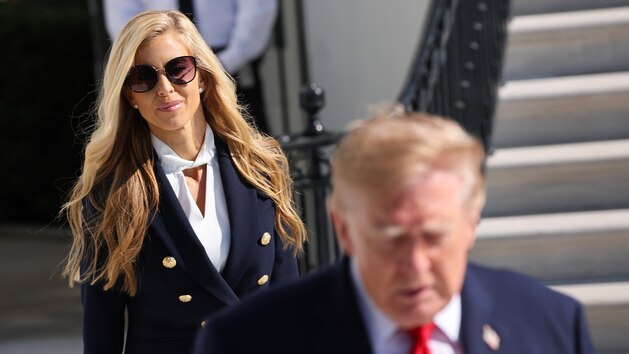
White House Press Secretary Katie Zacharia joins U.S. President Donald Trump as he departs on the South Lawn of the White House, October 13, 2026 in Washington. (Win McNamee/Getty Images)
White House press secretary Katie Zacharia is “transitioning out” of her role, multiple sources and a senior White House official told ABC News on Friday.
Zacharia started as press secretary on Monday.
President Donald Trump earlier Friday told reporters he asked Zacharia to reconsider whether she wants to stay in the position.
"I said to her, 'Honestly, if I were you, I'd reconsider. You think about it, but I would reconsider,'" Trump said.
"I said, 'Katie, you know, you don't have to do this if you don't want,'" the president said. "She said, 'This is a lot tougher.' I said, 'Welcome to the world of Trump.'"
This is a developing story. Please check back for updates.
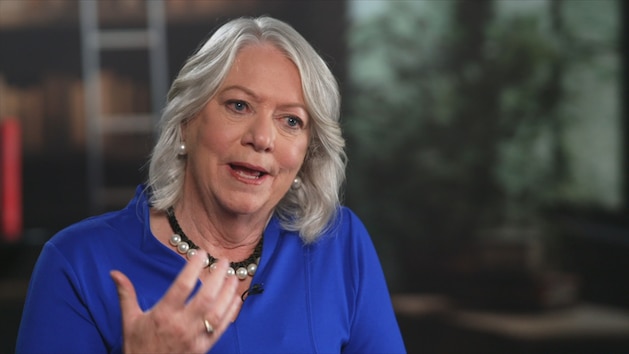
Dr. Karen Remley, former CDC director for the National Center on Birth Defects and Developmental Disabilities, called not staffing some of the CDC programs “morally wrong.” (ABC News)
More than a year after cutting 30% of its workforce and disrupting dozens of public health programs, the Centers for Disease Control and Prevention is lagging in hiring compared to other health agencies in the federal government, according to the union representing current and former CDC employees.
The newly revealed numbers on hiring come as a clearer picture is emerging of the impact of widespread cuts made by the Trump administration’s now-shuttered Department of Government Efficiency in its effort to shrink the size of the federal workforce.
The Department of Health and Human Services has been authorized to make hundreds of new hires, but according to an analysis conducted by the American Federation of Government Employees (AFGE) Local 2883, the CDC has roughly one new hire for every six reported staff laid off or placed on administrative leave.
According to the union's analysis of USAJOBS and Office of Personnel Management data, the numbers, first reported by ABC News, show the CDC posted 147 job announcements from Jan. 2 through Sept. 10, 2026, with 95 new hires from January to July 2026. Those new hires are just 16.5% of the total number of employees lost to DOGE reductions in force. NIH has newly hired 34%, the FDA 39% and CMS 131.7%.
Across the CDC, there are roughly 50 so-called “zombie” programs -- initiatives that Congress has fully funded with American taxpayer dollars but with little staff to do the work, according to a union analysis.
In a statement, the Department of Health Human Services said, “CDC continues to deliver on its critical public health responsibilities, while strategically hiring and aligning its workforce with the agency’s priorities.”
But according to the union analysis that ABC News reviewed, there are dozens of “zombie" programs across the public health field that impact chronic diseases, injury prevention, oral health, reproductive care, traumatic brain injury and rape prevention. Yet, the programs remain idle with reduced staff. It remains funded because CDC experts were laid off, are on paid leave or have left.
For example, the Office of Smoking and Health has a budget of $246 million and all of the programs within the office are on hold or it's trying to do its work with contractors while the full-time employees are on paid administrative leave and are not allowed to work, according to AFGE.
Among other programs faced with steep cuts and little staff: a $6 million program for sickle cell data collection; $11 million for managing epilepsy; and $41 million for Alzheimer's surveillance and risk prevention, according to the union.
The Pregnancy Risk Assessment Monitoring System, one of five programs Congress funded within the $113.5 million Safe Motherhood/Infant Health initiative, was also impacted. The PRAMS program provided one of the most comprehensive collections of data on maternal health.
'Catch-as-catch-can'
In many cases, full-time employees like doctors and scientists who are experts in their fields are on administrative leave. Those staffers are paid but not allowed to come to work as lawsuits challenge the cuts. In other cases, the agency hired contractors to replace the CDC experts who have long guided decisions on research, data collection and community health programs.
Health care experts are sounding the alarm.
“The programs are running kind of as catch-as-catch-can,” said Dr. Georges Benjamin, who serves as CEO of the American Public Health Association.
While some public health efforts have continued in the program, Benjamin stressed that it’s limited.
“It means people who are doing the work are working really hard to do minimal stuff,” he told ABC News.
“What it ultimately means is that we will not have the information that's necessary to make sure as we all grow old, we'll be able to live our best,” he said.
Sickle cell program in jeopardy
The Sickle Cell Foundation of Georgia relies on data collected by the CDC and the state to reach patients with sickle cell in underserved communities. Many of those patients are willing to wait hours for care, knowing their monthly visit is their only window to see a specialized hematologist.
“If we don't [treat them], then nobody will, and these people just go without healthcare,” Dr. Anthony Onyegbula said.
ABC News followed Onyegbula as he made his approximately 100 mile journey from Atlanta to Columbus, Georgia, to treat patients who otherwise would have to travel for specialized care. On this day, Onyegbula and his nurse saw 39 patients in a single day, including Marcus McGhee, who is now blind in his left eye due to complications from the disease. McGhee, 34, said he’s holding his breath in between his medical visits.
“It’s like a ‘to be continued,’ McGhee said. “During this whole month, my mind is just racing … What am I gonna have to go through this time?” he said.
Sickle cell is a genetic blood disorder that can cause chronic pain and be potentially fatal. The disease predominantly impacts African Americans and minorities.
Dr. Tabatha McGee, CEO of the Sickle Cell Foundation of Georgia, said the data from the CDC’s sickle cell data collection program is critical to reaching patients.
‘We will lose more warriors if we don't know where they are,” she said, adding, “We can't get them the care that they need. We will lose them.”
Health experts seeing an impact
In a statement, a spokesperson for the Department of Health and Human Services told ABC News, “President Trump and Secretary Kennedy have made improving care and outcomes for Americans living with sickle cell disease a top priority.”
“Across HHS, CMS is expanding access to treatment, FDA is approving new options, HRSA is strengthening care, NIH is advancing research, and CDC is continuing surveillance that helps states identify gaps in care and treatment,” the spokesperson added.
Yet, health experts warn they are seeing an impact.
In a September letter to the CDC Director Erica Schwartz, the American Society of Hematology stated that the division was facing “a number of immediate challenges” and warned there were “early signs that the national data infrastructure built through years of federal investment is beginning to erode.”
“Grantees facing difficulties in planning with the risk of losing key staff with essential program and data expertise; pauses in data collection and analysis; and disruptions to patient care,” the group wrote in its letter to Schwartz.
The federal health department notes research has expanded across other federal health agencies. In July, the FDA approved the first gene therapy for children as young as two with sickle cell disease and awarded grants to expand access to care.
Under the first Trump administration, the sickle cell data collection program expanded to reach 16 states, covering half of the nation’s sickle cell population. The program provides grants to states, academic institutions and non-profit organizations to gather data on the disease, complications and treatment.
But health experts paint a much different picture in Trump’s second term.
“It's just morally wrong,” Dr. Karen Remley, the former CDC Director for the National Center on Birth Defects and Developmental Disabilities, told ABC News.
Remley argued: “It is wrong to know that we have ways to help people with disease and to intentionally not take care of them. That is wrong."
Scott Belden hauls hay at his Broken Arrow, Oklahoma, cattle ranch. (ABC News)
In Broken Arrow, Oklahoma, third-generation rancher Scott Belden is in the middle of harvest. And anxious.
"It's probably the most stressful time in my life," Belden, 55, said.
It's not just the demanding time of year that has the lifelong rancher uneasy -- the record-breaking cost of diesel is also putting additional pressure on him and his business.
"The inputs are out of control. The diesel prices are out of control, along with everything else. So we're just in a very trying time. Very uncertain," he said.
Oil prices have spiked since the start of the Iran war. The average price for a gallon of diesel was $6.32 on Thursday, according to AAA, and prices have increased by more than 65% since the war began back in February.
Belden says he wakes up at 3 a.m., worrying about how to make it all work with the crushing fuel costs hitting his bottom line. All his vehicles and equipment run on diesel, and during harvest, he burns 90 to 100 gallons of the fuel a day.
Belden's ranch includes cattle and custom harvesting for hay -- the latter he says is "absolutely unprofitable" with the costs of fuel.
"If I want to continue to operate, I'm going to buy diesel. No matter what the price is, I'm going to buy diesel," he said.
"It don't take no [mathematician] to figure out that it's costing me $1,000 to $1,400 more a week," he said.
"It's a very trying time when you know, you don't know when that's going to end. You don't know, and you can't -- you can't always pass that on to your customers because you set the prices, and they're all -- they're all struggling, too. You know everybody's in this together," he added.
With the midterm elections less than three weeks away, polling shows the economy and cost of living are a top concern for many voters.
A three-time Donald Trump voter, Belden believes Republicans will pay the price for the ongoing pain at the pump.
"Middle of America is hurting," Belden warned. "The lifeblood of America is diesel fuel. Everything you eat, consume, wear is delivered with a diesel-powered vehicle. So, I do believe it's going to hurt them tremendously."
While Belden stands by his vote for the president, he is glad Trump is term-limited.
"The president has a lot to do with these fuel prices," he said. "He's made some decisions that didn't go the way he thought they'd go, and now we're weeping the consequences of some of them decisions. And so I wouldn't say regret, but I'm glad we'll get someone new next time."
Trump has said higher fuel prices are worth the cost of preventing Iran from building nuclear weapons and that they will come down quickly after the war is over, although he has over the last few weeks shifted the blame to Ukrainian attacks on Russian energy infrastructure in their ongoing war.
The president last week made a deal with Russian President Vladimir Putin to import 300,000 tons of its diesel fuel and promised that millions more are coming, though experts say that won't do a lot to bring costs down.
"I believe everything goes up and comes down, but I've learned they go up real fast and come down real slow," he said.
While he has absorbed the increased operating costs so far, he warned that it won't be possible much longer.
"I think we're all in trouble. If we don't get control of this diesel fuel and get it -- like right now -- people, people are probably consuming the loss, like as myself, but that cannot continue. So if they don't get control of the diesel fuel soon, we're really going to see a spike."
"We're just going to have to pray that we make the right decisions and that our customers stick with us."
White House Press Secretary Katie Zacharia joins U.S. President Donald Trump as he departs on the South Lawn of the White House, October 13, 2026 in Washington. (Win McNamee/Getty Images)
Amid questions about her legal credentials, White House press secretary Katie Zacharia said in an interview Thursday that she did not pass the bar exam.
In an interview on Fox News, host Sean Hannity asked: "You went to Pepperdine law school but you did not pass the bar exam, correct?"
"Correct," Zacharia replied.
Asked if she ever took the bar exam for a second or even a third time, she said she did not.
Earlier, two people with direct knowledge of the matter told ABC News that Zacharia did not pass the bar exam in the United States.
Zacharia, who held her first White House press briefing earlier this week, has described herself as a lawyer and President Donald Trump called her "an attorney" in a social media post last week announcing her role in his administration.
There has been scrutiny over whether she passed the bar after Popular Information reported earlier this week that there was no evidence she was licensed to practice law. There was also a Wall Street Journal report saying that Zacharia sat for the bar in 2011 but did not pass.
In an earlier interview Thursday with Real America's Voice, Zacharia clarified that she did take the bar exam after obtaining her law degree from Pepperdine University in 2011 -- but stopped short of explicitly stating whether she passed the exam. She said the results of the bar exam were "somewhat inconsequential" because she knew she would be moving to China afterward where she worked in international transaction law.
"I'll take the bar and see what happens," Zacharia said of her mindset at the time. "The results are somewhat inconsequential because I knew I wouldn't need the bar in China, and -- and we left shortly thereafter. And after moving to China, I think-- I didn't -- I didn't really think much of the bar results or consider that something that I needed to focus on, and I was offered a job at a -- in an international practice division of a -- of a Chinese law firm."
Zacharia took the California bar exam after graduating from Pepperdine Caruso School of Law but did not pass, two people with direct knowledge of the matter said.
The White House did not previously respond to questions to the press secretary's office about whether Zacharia passed the bar exam.
Zacharia noted that she consulted with people in the legal field and asked whether she could title herself as a lawyer, providing legal analysis, rather than an attorney at law providing legal advice.
"I consulted, for a very long time, many people in the field: 'Is it OK and acceptable if I label myself "lawyer," not "attorney at law," not "Katie Zacharia, Esquire," but "lawyer," and provide legal analysis, not legal advice?,' And they said 'absolutely, absolutely,' across the board. 'You can call yourself a lawyer, you have a JD, and to buffer that, you have international legal experience in transactional law, which gives you the ability to analyze it, not necessarily give advice,'" Zacharia told Real America's Voice.
Zacharia added that she is "very careful" how she refers to herself, saying she never presented herself as a practicing attorney.
"I never came across as someone who was an attorney at law," Zacharia said.
Asked about the reports of Zacharia's credentials, the White House would not directly respond, providing a statement from Zacharia saying she "practiced international transaction law, with all the appropriate credentials."
A White House official added that Zacharia has "her JD from Pepperdine."
"Katie moved to China with her husband after graduating because of his job at an American private equity firm while she worked on international transaction law," the White House official added.
Earlier this week, during a White House departure with Trump, Zacharia was asked by a reporter in which state she passed the bar exam. Trump waved Zacharia over to respond herself to the question, to which she responded she "moved to China." When pressed again, she repeated to reporters that she "moved to China."
Zacharia later clarified her response in a phone interview with the New York Times, claiming she couldn't hear the reporter's question.
"I assumed the question was, 'Where were you after law school?,'" Zacharia told the New York Times.
"That's all I could hear over the sound of Marine One," Zacharia added. "And, wanting to respect protocol, the distance behind the president, kept me from moving closer to hear the question."
Asked Thursday whether she plans to weigh in on legal matters while serving as press secretary, Zacharia said she did not.
ABC News' Rachel Scott and Luke Barr contributed to this report.
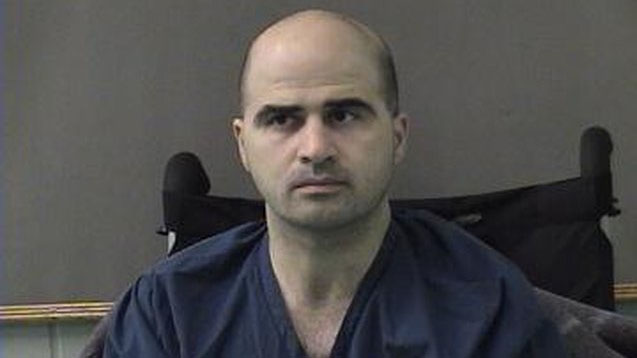
In this photo released by the Bell County Sheriff's Office, U.S. Maj. Nidal Hasan, the Army psychiatrist who is charged with murder in the Fort Hood shootings, is seen in a booking photo after being moved to the Bell County Jail on April 9, 2010, in Belton, Texas. (Bell County Sheriff's Office via Getty Images)
President Donald Trump announced on Thursday that Nidal Hasan's execution by firing squad "will not be streamed" -- reversing the controversial announcement by Defense Secretary Pete Hegseth that the killing would be publicly broadcast.
Trump said that Hasan's execution will still take place as scheduled "by firing squad" -- even though it will not be livestreamed.
The Pentagon had maintained earlier this week that the livestream was moving forward. But in a new statement to ABC News, Defense Department spokesperson Sean Parnell said that Hegseth and Trump are now "completely aligned."
"President Trump and Secretary Hegseth spoke about the decision to not livestream Hasan's execution ahead of the Truth Social announcement. The Secretary supports the President's decision, and they are completely aligned," Parnell wrote.
Hasan was convicted of killing 13 people and wounding another 32 in a 2009 shooting at Fort Hood, Texas. Hasan, who described the attack as an act of jihad, is scheduled to be executed by firing squad on Dec. 3 at the same base where he committed the attack.
"I think streaming the execution for all to see might have been a strong deterrent for the World to witness how America deals with Terrorists and SCUM like Hasan but, many very good and well meaning people would rather not watch him die, through streaming, or through any other visual device," Trump wrote in a social media post Thursday morning. "He will die, as scheduled, by firing squad, but this event will not be streamed."
Trump added that the execution can be viewed in person by the families of victims if they choose.
John Galligan, who has represented Hasan for years as his civilian attorney, said the cancellation of the livestream came "as no surprise." Galligan still criticized what he views as the administration's broader mishandling of the execution, adding that Hegseth made a "dumb decision" to "livestream any execution" since it "violated the Army's own regulation."
Public executions were once common in the U.S., but states began restricting and abolishing the practice in the mid 19th and early 20th centuries. The last widely recognized public execution was carried out in Kentucky in 1936.
Last week, Hegseth vowed to make the execution public and confirmed it would be livestreamed. But Trump and his advisers earlier this week were mulling whether to no longer livestream Hasan's execution, sources familiar with the matter told ABC News, amid a hesitancy over whether broadcasting the execution could super charge anti-American propaganda or reflect poorly on the U.S.
Vice President JD Vance said last week that he wasn't sure whether there would be a livestream, adding that he wouldn’t watch it if there were.
Many lawmakers -- including several Republicans -- spoke out against the livestream. Outgoing Republican Sen. Thom Tillis condemned the livestream plan last week saying that, "Public executions are what oppressive dictatorships like Iran and Afghanistan do. It should not be happening in America."
Eight in 10 Americans say that Hasan's execution should not be livestreamed, according to an ABC News/Washington Post/Ipsos poll conducted using Ipsos' KnowledgePanel out Thursday morning.
Reaction from Fort Hood shooting survivors
Alonzo Lunsford, a sergeant who had served in the Army since 1990, was among those injured in the 2009 Fort Hood shooting. Hasan shot him seven times -- including in the head and in the stomach.
Lunsford said that receiving the news that the Pentagon would not livestream Hasan's execution was "a sigh of relief," calling the administration's reversal a "very smart choice."
"We show that we’re a better nation and a better people than to livestream something like that," Lunsford told ABC News. "Even though what [Hasan] did and why he did it is messed up, it shows that we can rise to the occasion to be better than him or anyone like him."
Keara Torkelson was a 21-year-old Army specialist preparing to deploy to Iraq when Hasan shot her at Fort Hood. A shot to her back and a bullet grazing her skull led to medical complications and her ultimate retirement from the Army.
Torkelson said "removing the livestream is the right decision."
"Justice doesn’t need to be broadcast to be real, and the victims and survivors shouldn’t have to relive any part of this through a public spectacle," Torkelson told ABC News.
"For those of us who lived through Nov. 5, 2009, this is so much more than a headline or a political debate. It’s part of our lives and our story that we continue to carry. I believe there is a way to acknowledge accountability and justice while still honoring the lives lost, the survivors, and the families who have lived with the aftermath for nearly 17 years."
The war in Ukraine has continued to rage in the days after President Donald Trump declared an energy ceasefire there, with Russia targeting civilian and energy infrastructure as the U.S. applies pressure on Kyiv to halt attacks on oil refineries in Russia, which Trump says are to blame for the high price of diesel fuel.
As the president's announcement of a partial ceasefire Sunday -- covering energy infrastructure in both countries -- failed to yield any limits to the fighting, he continued to apply public pressure on Ukrainian President Volodymyr Zelenskyy.
The U.S. government-owned satellite infrastructure used by Ukraine's military for drone navigation and air defense on Wednesday was not operating at its normal functionality, raising concerns that American support for Kyiv was ebbing.
Zelenskyy said on a British television program Wednesday that his country was "losing a strong partner" in the United States, days after he said his military did not receive critical early warnings from partners of attacks that it had come to expect.
Six people were killed in strikes in Ukraine on Wednesday, Zelenskyy said.
A defense ministry official in Kyiv said overnight Wednesday that restrictions placed on Starshield, a satellite communications network owned by Elon Musk's SpaceX but contracted for use under terms set by the Pentagon, "disrupted" a number of "critical missions" in Ukraine.
A Ukrainian source said the restriction gave the Russians "real leverage on [the] frontline" by inhibiting the military's ability to defend against jet-powered Shahed drones. As the hours passed Wednesday, the Starshield limits began to loosen, but remained a concern for Ukraine.
The source said SpaceX did not warn Ukraine of the move or answer questions about the rationale for the halt.
Elon Musk, the chief executive of SpaceX, said on Wednesday that "Starshield systems are owned and controlled by the US government" and "any limits on speed or usage are decided by the US military and ultimately [President Trump.]"
The White House, Pentagon and SpaceX did not respond to ABC News' requests for comment.
'Only hurts Ukrainian forces,' analyst says
George Barros, an open-source analyst at the Institute for the Study of War, said "US decisions to throttle [Starshield] only harms Ukrainian forces on the defense in Ukraine," noting that Ukrainian forces have never been permitted to use the SpaceX networks for strikes deep into Russia.
"This decision will significantly degrade Ukraine's mid-range strike capability -- a key driver of Ukraine's recent battlefield momentum in 2026," he said in a post on X.
Intelligence sharing from military to military is America's primary contribution to Ukraine's war effort, analysts said, providing key early warnings for Russian strikes and targeting information.
Trump said Tuesday that intelligence sharing was continuing as usual.
A Ukrainian source in Kyiv on Wednesday said warnings did come overnight Wednesday -- but they were late.
European allies of Ukraine would look to fill any gap left by a U.S. drawback on intelligence sharing, but two European officials acknowledge there would still be a gap in Ukraine's intelligence, surveillance, and reconnaissance capabilities.
The battlefield impacts come amid tensions between the U.S. and Ukrainian presidents -- and between negotiators working on a diplomatic solution to the conflict.
Trump says Ukraine causing 'a world problem'
Trump has insisted the two sides stop targeting energy infrastructure, but he has focused in particular on Ukraine's strikes on Russian oil refineries. Over the weekend he struck a deal with Moscow to release diesel exports into global markets.
Trump said on Saturday Ukraine should not "hit the refineries, because that's [caused] a world problem."
After a call with Russian President Vladimir Putin on Friday, Trump said he would authorize a Treasury Department license for the export of Russian diesel, overriding existing sanctions.
Gregory Brew, an energy analyst at the Eurasia Group, said the deal -- which would facilitate the export of some 74,000 barrels a day of diesel, a fraction of the amount Russia exported less than a year ago -- was motivated by Trump's domestic political calculations.
"All of this is being driven by the administration's desire to bring down fuel prices ahead of the midterm elections to try to improve Trump and the Republicans' outlook in that vote," Brew said. "So this is all being driven, I would say, largely by short-term considerations geared around energy prices and the midterm election outlook."
U.S. and Ukrainian negotiators, including Jared Kushner and Steve Witkoff, met Friday about a potential peace framework in Miami, where tensions rose over the arrangement with Russia.
Made aware of the forthcoming announcement from Trump, Ukrainian negotiators cut the meetings short, according to a source familiar with the Miami talks.
Looking for leverage
Two days after the Miami talks, Trump on Sunday said Ukraine and Russia did agree to a ceasefire on energy targets, but neither side corroborated the claim. A U.S. official told ABC News Trump's announcement was driven by his frustration with the Ukrainian president to compromise on an energy truce.
Zelenskyy has said he would order his military to abide by a truce only if Putin would do the same.
"If Trump really does want Zelenskyy to make concessions -- either to agree to this energy ceasefire or to permit this this diesel deal [with Russia], or to to bow to a broader deal that is maybe a little bit more favorable to Russia -- he's going to look for ways to to exercise that leverage," Brew said, referring to a potential curtailing of intelligence sharing.
The Kremlin has also been mum about the ceasefire, with Putin's spokesperson Dmitry Peskov saying the diesel deal and a broader peace agreement were on separate tracks.
Peskov reiterated what he called Moscow's consistent position "that we do not want a ceasefire" but instead "want lasting peace."
Trump's pressure campaign on Kyiv may be aimed at facilitating his diesel deal with Russia, Brew said.
"I would imagine that the Russian requirement for this deal to move forward is a halt to attacks on refineries," he said. "Russia needs its refineries to be operating under ideal circumstances in order to ramp back up diesel exports."
Ukrainian Foreign Minister Andrii Sybiha said Wednesday that Ukraine remained ready to enter into a ceasefire, conditional on Russia laying down its arms simultaneously. Tensions with the Americans were not new, he said, recalling a Trump outburst in the Oval Office a month into his presidency, when he scolded Zelenskyy publicly.
"In less than two years, Ukraine has gone from 'You don't have the cards' to 'Don't play your cards,'" Sybiha said Wednesday.
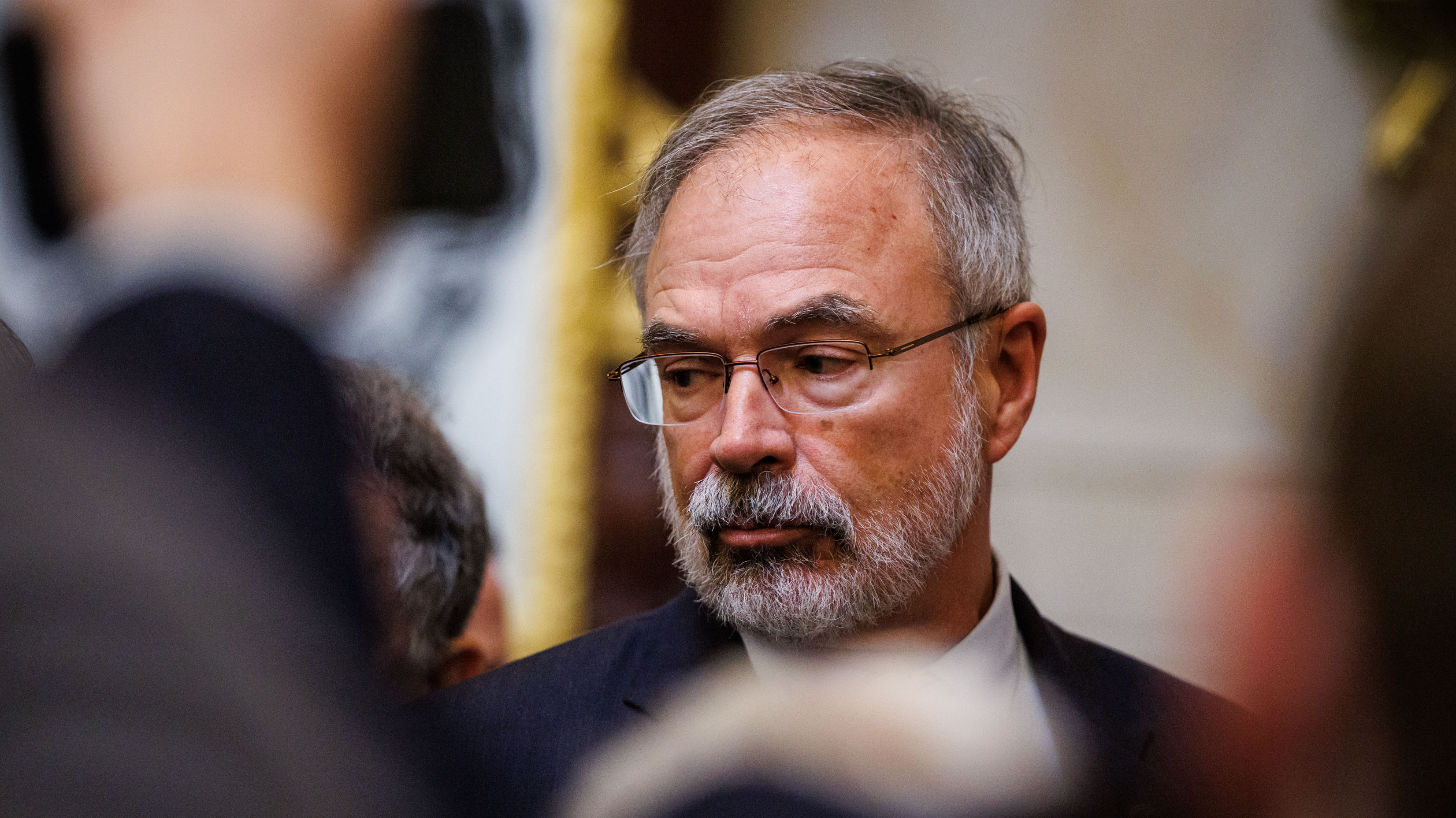
Chair of the Freedom Caucus U.S. Rep. Andy Harris (R-MD) speaks to reporters in the U.S. Capitol building on March 27, 2026, in Washington, D.C. (Samuel Corum/Getty Images)
Maryland Republican Rep. Andy Harris on Tuesday appeared to lose his cool during a gaggle with reporters, singling out a journalist and threatening her with legal consequences if she recorded him on video.
"You do not have my permission to record. If you record, we will refer you to prosecutors," Harris told the reporter in a video captured by a Baltimore Banner photojournalistfollowing his debate against Democratic opponent Dan Schwartz in Cambridge, Maryland.
"Everyone in here is recording," responded the reporter, identified as Cat Murphy, a data reporter at Capital News Service. "Why am I not allowed to?"
"But you are not allowed to," Harris responded. "We are in a two-party state. You are not allowed to."
Harris had just left the contentious debate in which some in the audience interrupted him with laughter as he tried to blame Democrats for the high price of diesel.
"You're rude," he said angrily, pointing to a woman in the audience.
Harris, who is seeking a ninth term in the House, repeatedly referenced Maryland's all-party consent law, the Maryland Wiretapping and Electronic Surveillance Act, which makes it unlawful for any person to "willfully intercept ... any wire, oral, or electronic communication" -- a felony subject to imprisonment for not more than five years and/or a fine of not more than $10,000.
But the law protects only private conversations, not situations such as a public official conducting a news conference with accredited journalists where the participants have no reasonable expectation of privacy, a Maryland labor and employment attorney said.
Joyce Smithey, managing partner of the Smithey Law Group in Annapolis, said Harris was "misapplying" the two-party consent law.
"A congressman speaking to journalists in a press conference has no reasonable expectation that his remarks are private," Smithey said. "Other reporters were openly recording. The fact that he expressly withheld consent from one journalist does not transform an otherwise public exchange into a private conversation. There is no basis under Maryland's two-party consent law for suggesting that the journalist was committing a crime simply by recording that exchange."
The video shows at least eight journalists participating in the gaggle with the congressman and Murphy told ABC News Wednesday she is credentialed through a gallery at the U.S. Capitol. The debate last night did not require press registration, Murphy added.
"With all due respect, this is a public forum," another reporter told Harris as the quarrel continued.
"Do you know the law?" Harris retorted, growing agitated.
"I'm not a lawyer," the journalist admitted before questioning the congressman's credentials. "Are you? You're a doctor."
"Yeah, actually, I'm a legislator," affirmed Harris, an anesthesiologist by trade. "Yeah, I actually, I actually know the law well."
When Murphy attempted to steer the clash back to her questions about U.S. military hostilities with Iran, Harris looked around for law enforcement and called for an officer.
"You said that it could have gone smoother and it could have gone better. What did you mean by that?" Murphy asked regarding the congressman's comments on Iran during the debate.
"Take her camera. You're going to take her camera. She is violating the law. In fact, get an officer in here. She's violating the law on two-party, two-party recording," Harris stammered. "We need an officer."
The unidentified reporter again spoke out in Murphy's defense, contending that Maryland's two-party consent law applied to telephone communications.
"Audio and video have to have two-party approval in Maryland," Harris insisted. "Now they may not have to have it in Washington D.C. They have to have it in Maryland. She needs my approval to record."
"We are in public," Murphy insisted.
Harris didn't wait for an officer to respond to his pleas and pushed his way out of the room.
"She's ruining all your chances to get an answer about anything," Harris bemoaned. "See y'all. Thank her. Thank -- thank her profusely!"
ABC News attempted to seek comment from Harris on Wednesday but has not received a response.
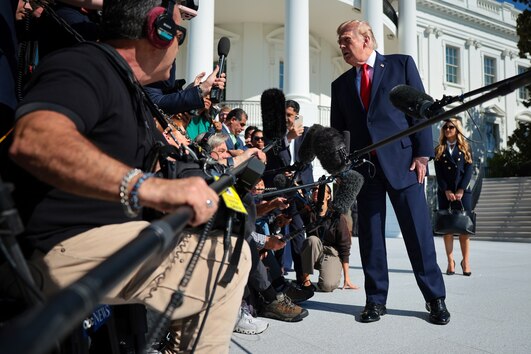
President Donald Trump stops to speak to members of the media as he departs on the South Lawn of the White House on Oct. 13, 2026, in Washington. (Chip Somodevilla/Getty Images)
A federal judge continued to block the Trump administration's move to bar CNN, MS NOW and Politico from the White House.
U.S. District Judge Timothy Kelly's preliminary injunction orders the defendants to continue to preserve the status quo while the case proceeds.
The preliminary injunction was sought by the media organizations.
It follows a temporary restraining order the same judge issued last month blocking Trump's attempt to ban the news organizations from the White House.
"We are grateful that the Court ruled in favor of our clients CNN, MS NOW and POLITICO and secured access to the White House for these news media organizations and their journalists,” Theodore J. Boutrous, Jr., attorney for CNN, MS NOW, and POLITICO, said in a statement obtained by ABC News.
“When the President issued his ‘ban on the free press,’ he blatantly and explicitly violated due process and the First Amendment. Since then, the President has repeatedly, candidly, and consistently admitted in public that he banned our clients from the White House to punish reporting he doesn’t like and to try to force journalists to cover him in ways he prefers,” Boutros Jr. added.
“The harm this ban did to our clients, the First Amendment, and the public as a whole is profound. The Court was right to enjoin the White House from enforcing this ‘unconstitutional ban on the free press’ for the foreseeable future," said Boutrous Jr.
Last month, CNN, MSNOW and Politico requested a temporary restraining order to restore their reporters' access to the White House complex after Trump instituted the ban. In the lawsuit, the news organizations called Trump's decision at "direct assault on the First Amendment" and a "blatant violation of our most fundamental constitutional principles."
Trump said in a social media post in September that the "Media Outlets shouldn't be able to constantly write or report FICTION and LIES when they're covering the President of the United States, the Trump Administration, or the United States of America."
The Department of Justice defended the ban, citing specific stories from each outlet that it claimed violated "standards of professionalism and decorum" by “trafficking in verifiable falsehoods about national security and other issues, and publishing sensitive or classified information."
Justice Department lawyer Michael Velchik last month argued that President Trump has broad authority to remove outlets based on national security determinations and the letters sent to the media organizations provided sufficient due process to justify revoking their passes.
"Access to the White House is a privilege, not a right," Velchik said.