
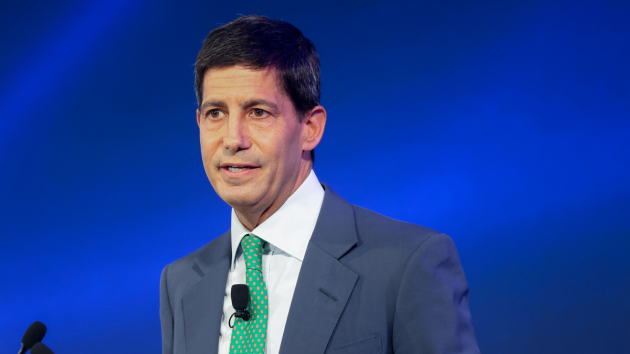
(WASHINGTON) -- President Donald Trump’s selection to chair the Federal Reserve, Kevin Warsh, testified in a Senate confirmation hearing on Tuesday as his nomination faces bipartisan opposition centered on a federal criminal investigation into the central bank’s current leader.
The probe into Fed Chair Jerome Powell, which focuses on alleged false testimony to Congress about an office renovation, threatens to derail or delay Warsh’s nomination.
Powell, who was appointed by Trump in 2017, has rebuked the probe as a politically motivated effort to influence interest-rate policy.
In his opening remarks, Warsh voiced support for the independence of the Fed in its role setting interest rates. He used the term "monetary policy" to describe the central bank's task of adjusting benchmark borrowing costs.
"Monetary policy independence is essential. Monetary policymakers must act in the nation’s interest," said Warsh, a former Fed official.
Still, Warsh defended the right of public officials, including presidents, to voice their views on interest-rate policy, saying such comments do not infringe on Fed independence.
"Central bankers must be strong enough to listen to a diversity of views from all corners," Warsh said.
Warsh said he welcomes collaboration with the White House and Congress on "non-monetary matters that are part of the Fed’s remit," such as banking regulation.
Sen. Elizabeth Warren, D-Mass., the top Democrat on the committee, responded directly to Warsh's defense of a president's right to criticize the Fed, saying the federal investigation of Powell amounts to a pressure campaign that extends beyond public criticism of Fed policies.
"You said it’s perfectly fine for elected officials to state their views on interest rates. But that’s not what Donald Trump is doing," Warren said, addressing Warsh.
The investigation of Powell, Warren added, is "designed to threaten all the members of the Fed to do Trump’s bidding."
Warsh may become Trump's "sock puppet" atop the Fed, Warren said.
When the Department of Justice's investigation into Powell became public, in January, Trump denied knowledge of the probe, NBC News reported at the time.
Later in the hearing, Warsh told Sen. John Kennedy, R-La., that he would “absolutely not” be a sock puppet for Trump.
"I'm honored the president nominated for the position, and I'll be an independent actor if confirmed as chairman of the Federal Reserve," Warsh said.
Sen. Tim Scott, R-S.C., the chairman of the Senate Banking Committee, praised Warsh, saying the Fed nominee would focus Fed policy on economic stewardship. During the tenure of President Joe Biden, Scott claimed, the Fed shifted some of its attention to the implications of issues like climate change.
“An independent Federal Reserve is essential to achieving its mission. That independence must be protected," Scott said.
"Kevin Warsh is battle-tested and brings the necessary experience," Scott added.
Sen. Thom Tillis, R-N.C., a potentially decisive vote on the committee, says he will not move to advance Warsh's nomination until the Department of Justice resolves its unprecedented investigation into Powell.
Powell's term as Fed chair ends on May 15, but he said last month he would stay in the position until Warsh is confirmed. For his part, Trump told Fox Business last week he would fire Powell if the current Fed chair attempts to remain in office past the end of his term.
Warsh, who previously worked on Wall Street and in the President George W. Bush administration, brings experience in finance and policymaking.
He is currently a fellow at a conservative think tank called the Hoover Institution, which is based at Stanford University. He also works as a partner at the Duquesne Family Office, an investment firm founded by billionaire and former hedge fund manager Stanley Druckenmiller.
In 2006, Bush appointed Warsh to serve on the Fed’s Board of Governors, a top policymaking body that helps set the level of interest rates, where he served until 2011. His tenure overlapped with the 2008 financial crisis, during which he helped manage the central bank’s response under then-Chair Ben Bernanke.
The nomination of Warsh arrives at a delicate moment for the Fed, as it grapples with a challenging combination of elevated inflation and sluggish hiring. An interest-rate hike could help ease inflation but risks a further cooldown of the labor market, while a rate cut may boost hiring but threatens higher inflation.
During his term as a Fed governor in the late 2000s and early 2010s, Warsh gained a reputation as an interest-rate “hawk,” meaning he generally preferred higher interest rates as a means of ensuring low and stable inflation.
In recent months, however, Warsh has voiced support for lower interest rates, rebuking the Fed’s concern about inflation risk posed by a flurry of new tariffs issued last year.
Those remarks came before the U.S.-Israeli war with Iran, however, which sent inflation soaring last month.
The rapid acceleration of price increases could complicate interest rate policy at the Fed, which may be reluctant to lower borrowing costs as inflation climbs.
ABC News' Elizabeth Schulze, Sarah Kolinovsky and Brittany Gaddy contributed to this report.
Copyright © 2026, ABC Audio. All rights reserved.









.jpg)


